
How Language Divides Us
Introduction to Political Abstraction

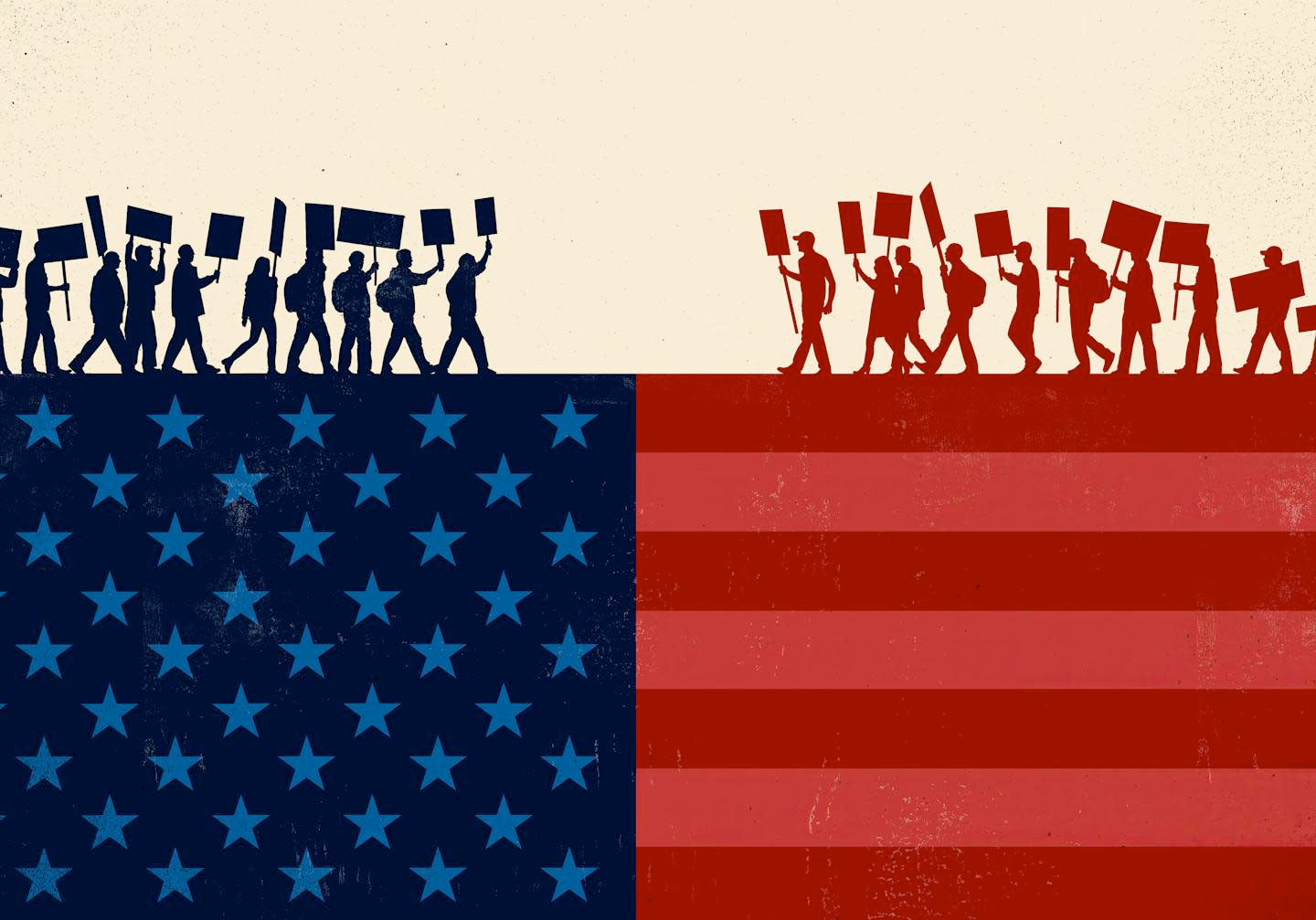
About a year ago, I read The Righteous Mind by Jonathan Haidt, which is a book that explores the psychology of people talking about important issues. It asks the question: Why are good people divided by politics and religion?
In the book, Haidt argues that people don’t reason their way to moral conclusions; they feel their way there and then construct arguments afterwards. It’s a fantastic book that gives context to the political division this country faces through the lens of moral psychology.
What follows is not an attempt to answer that question better than Haidt (who is a distinguished professor of psychology at NYU), but to approach it from a different angle. I recently graduated with a master’s degree in computer science, and while I am not a computer genius by any stretch of the imagination, studying how computers manage complexity gave me a useful lens for thinking about why political discourse so often breaks down. This lead me to my fascination with the concept of abstraction.
At its core, abstraction is the process of managing complexity by selectively hiding detail. It is not just a useful technique, but an absolute necessity. Without abstraction, both human reasoning and modern computing would collapse under the weight of their own detail.
Abstraction in Computer Science
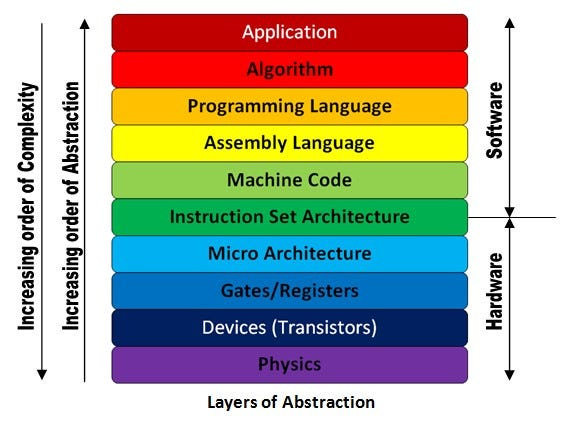
At a high level, a computer is a stack of abstractions. At the bottom are individual electrons flowing through transistors. Those signals are organized into logic gates, which form instructions, which are then interpreted by a processor. On top of that sit operating systems, programming languages, and finally apps that people actually interact with. It’s an extremely complex system, one that no single human can know everything about in its most granular detail.
Because of this, it is impossible to talk productively about computers without abstraction. Imagine if every time an app developer tried to fix a bug, they had to reason at the level of atoms or transistors. You can almost hear the conversation:
“Oh, we ran into a Run Time Error - the issue is that electrons aren’t flowing correctly through these billion transistors, which prevents a voltage change from propagating through these billion logic gates, which then fails to trigger the correct instructions to reach the Instruction Set Architecture, which means the compiler emits the wrong machine code…”
You get the point.
That would be absurd. Software development would grind to a halt under the weight of unnecessary detail.
What happens instead is that engineers abstract away layers that are irrelevant to the problem at hand. Application developers don’t think in terms of transistors, logic gates, or assembly. They work at higher levels, each a layer that has been iterated upon to allow them to reason about what a system does rather than how every electron gets to where it needs to be.
Abstraction in Politics
This system of zooming in and out of details is an unavoidable feature of language, and is extremely important in understanding the current state of political discourse. Sometimes it is appropriate to speak in terms of broad principles or values; other times, the discussion demands attention to policy design, or individual lived experience.
Politicians are great at this. They know when to use vague slogans as rallying cries, and when to bring up individual anecdotes to inspire moral urgency. Great debaters practice not just how to fill in the granularity of the details on which they can speak, but also to adjust the granularity accordingly to fit their objectives and become an effective speaker.
However, I would argue that this starts to ruin discourse when it becomes a way to avoid thinking rather than a way to think more clearly. Instead of helping us manage complexity, adjusting abstraction levels become a tool for malicious parties to frame conversations divisively.
Lets see how these failures in abstraction appear in practice.
Labels
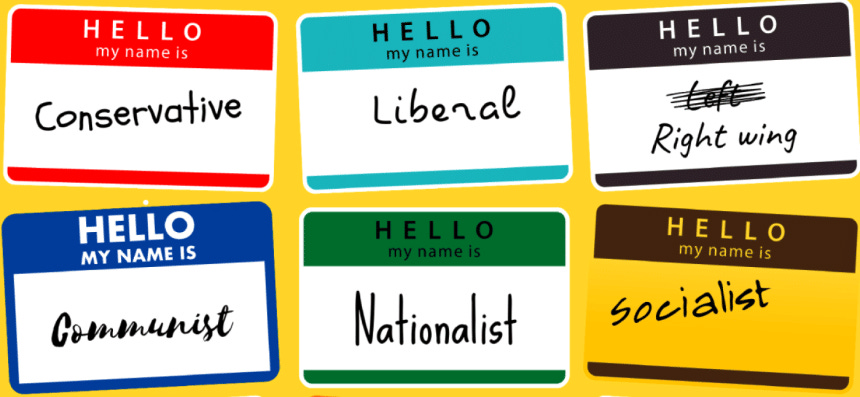
A common way abstraction breaks political discourse is when labels are used as endpoints rather than invitations to think further. A single word is made to carry the weight of an entire argument.
‘Woke’ gets used by conservatives to prematurely discount a broad range of ideas that promote equity, social reform, or institutional critique, regardless of how practical and inoffensive the proposal actually is.
‘Racist’ gets used by liberals to function as a moral endpoint that allows an argument to be dismissed on character grounds alone, bypassing engagement with the underlying claims at issue.
‘Globalist’ is deployed by the far-right to discredit arguments involving international cooperation, trade, or multilateral institutions.
‘Socialist’ is often used by Republicans to collapse a wide range of policy proposals (public healthcare, student debt relief, labor protections) into a single ideological category that simplifies opposition.
Importantly, these labels are not 100% wrong. There are, of course, anarchists who reject capitalism in the ‘woke’ category, just as there are genuinely bigoted individuals who warrant the label ‘racist’. The problem lies in how loosely and indiscriminately these labels are applied. At best, this creates confusion by collapsing meaningful distinctions; at worst, it replaces analysis with caricature, allowing complex positions to be treated as unworthy of further examination.
Is the liberal the person who supports Israel’s secular and democratic society or the person who stands up for the disenfranchised Palestinian civilians? Does the conservative value the individual rights on bodily autonomy or the intervention of religious practices in dictating law? Some progressives support something approximating segregation (whether that is for good or for bad is a separate topic), and Republicans are now the anti-free-trade party of the working class. Call me a bit idealistic but I want clean, long-lasting labels that do not require constant semantic maintenance.
Once these labels are maliciously applied, the conversation shuts down. The details underneath, such as the policy specifics, the mechanisms, and the incentives, fade from view. The abstraction is treated as enough, and the labels flatten entire philosophies and arguments into something that can be summarily dismissed.
Framing Granularity
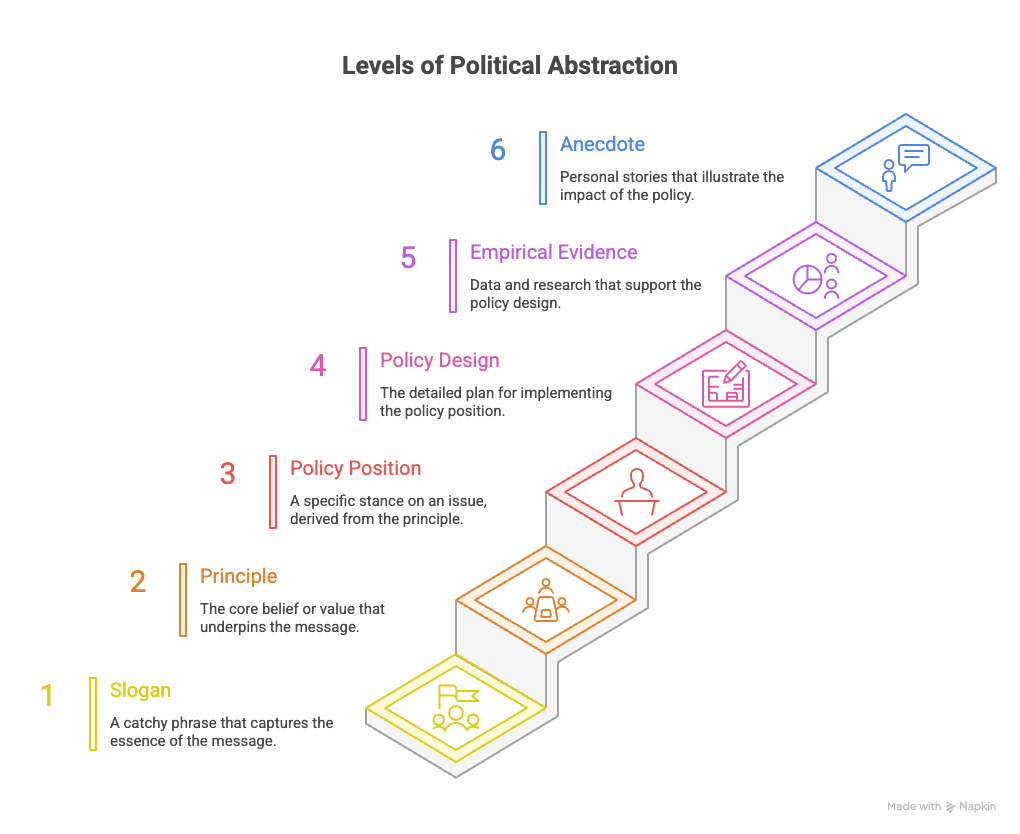
Another way abstraction degrades political discourse is through the intentional control over granularity. Specifically, I am talking about the ability to adjust the level at which one’s own arguments are framed, while purposefully constraining the level at which opposing arguments are framed.
Effective speakers are rarely committed to one level of abstraction. Instead, they strategically move across these levels.
When a broad principle is questioned, discussion retreats upward into moral language. When that moral framing becomes strained, discourse drops downward into selective anecdotes that reassert emotional authority.
Statistics are authoritative until they complicate the narrative, at which point they are dismissed as dehumanizing or incomplete. Lived experience is elevated as definitive until it conflicts with broader claims, at which point it is reframed as unrepresentative.
Each level is treated as decisive only when it supports the desired conclusion. The failure lies not in what level of abstraction is used, but in the pretense that any single level is sufficient, especially in describing an opposing viewpoint. A common strategy for debaters is to maintain the freedom of movement for one’s own claims while denying that freedom to others.
Compounding this problem is the fact that political figures often develop deep fluency across multiple levels of abstraction for the positions they support. They have talking points, examples, statistics, and prepared rebuttals to common counterclaims.
What they rarely have is an equally structured engagement with a full range of counterarguments accompanied by good faith reciprocity. For any given position, there is one argument to defend and a theoretically infinite set of objections to consider. Faced with that imbalance, it becomes far easier and practical to compress opposing viewpoints into simplified versions than to grapple with them in their strongest form. Repetitive talking points rarely address the specific question or counterpoint at hand, and a whataboutism is purely an attempt to deflect self-reflection.
Honestly, I could go further analyzing rhetorical technique, but one of my favorite YouTubers, Nerdwriter1, made a great video about this topic with a certain politician.
Abstraction as a Tool or a Weapon
In computer science, abstraction is a tool. In political discourse, abstraction is often, although not always, treated as a weapon.
A good engineer knows when to abstract away unnecessary details, and knows when to adjust their sights to a different layer. Reality asserts itself in the form of bugs, crashes, latency, or security breaches, and no amount of eloquence can talk a broken system into functioning. The engineer is rewarded when the whole system works.
Political discourse operates under different incentives. An articulate person who knows their position thoroughly can shift abstraction levels with ease, zooming out to moral principles when details are inconvenient, and zooming in to cherry-picked anecdotes when principles are under threat. The abstraction is adjusted not to reflect reality more accurately, but to preserve rhetorical advantage.
Arguments succeed when they mobilize support, not when they withstand scrutiny over time. The other (I would argue more commendable) choices, such as admitting uncertainty or engaging in genuine listening, are not rewarded in the battleground of political discourse.
This is not an argument against abstraction itself - it is just as necessary in political discourse as it is in engineering. For example, you cannot meaningfully discuss illegal immigration by focusing solely on a single individual who was unfairly deported, just as you cannot rely on hollow abstractions like “The Welfare State” or cliches like “Make America Great Again” to explain a complex system. Productive discourse requires movement across these levels, from principles, policies, to lived experience, without allowing any single abstraction to stand in for the whole.
Engineers are trained to treat abstractions as provisional. They assume they are temporary simplifications that remain valid only as long as they continue to match reality, and must be revised when they no longer do.
My argument is that the many failures of political discourse stem from abandoning the engineer’s discipline of provisional abstraction, and that recovering it would reconnect arguments to the realities they claim to describe.
Limitations + Conclusion

Let’s step back a little bit.
One of my least favorite things about any expert, intellectual, or hobbyist discussing politics is that they tend to see problems exclusively from one lens.
Those who study economics start charting supply/demand curves to explain income inequality.
Those who study psychology frame political disagreement as cognitive bias.
Those who study law interpret social conflict through the question of rights, precedent, and procedural fairness.
Those who study sociology emphasize systems, power, and historical context.
Those who study hotel administration see political hostility as a result of poorly folded napkins.
Each lens captures something real, but are insufficient when alone.
This essay is no exception. Technologists reach for optimization problems and incentive structures. I wanted to write this essay because it’s interesting to me to analyze politics from a detached perspective. But that’s not the point of politics.
Stripping away the emotional gravitas that often accompanies political discourse is 1. impossible and 2. not ideal considering emotional context carries meaning that analytical frames cannot fully capture. Politics, ultimately, are an extension of human values. The intensity people bring to political issues is often rooted in personal experience, and it is in this individual experience that people derive their sense of meaning, identity, and moral urgency.
This essay is not meant to denigrate that passion or suggest that political engagement should be emotionally neutral. Rather, it is a call for greater care in how those convictions are translated into argument.
Beneath all the vitriol and division, I want to recognize that there is a shared human impulse that the vast majority of people share. It is the desire to protect, to belong, and to make sense of our chaotic world.